




With pre-season football in full swing, Fantasy Premier League (FPL) managers will naturally start taking note of results, individual form and possible bargains.
However, should we be reading much into these? Is there a correlation between friendlies and the subsequent league campaign?
Let’s look at how 2025/26’s summer unfolded.
TEAMS IN PRE-SEASON
Using last time’s ultimate pre-season guide and the graphic below, we can see that Liverpool, Manchester City, Chelsea, Brighton and Hove Albion, Fulham, Brentford, Aston Villa and West Ham United had good win rates (giving precedence to later ones).
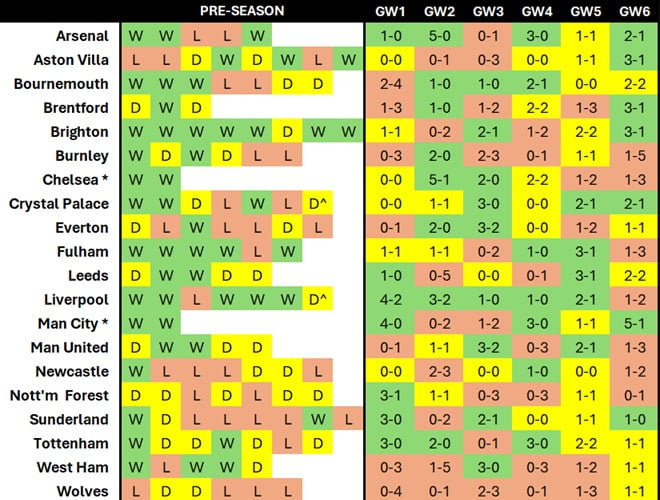
* Chelsea and Man City were at the Club World Cup ^ Crystal Palace v Liverpool was the Community Shield
But, after Gameweek 6, their league standings were first, seventh, eighth, tenth, 11th, 13th, 16th and 19th respectively.
Apart from the table-topping Reds – champions of 2024/25 – these others averaged 5.43 points after five outings.
Villa were goalless across their initial four and didn’t win until match six. Brentford’s sole early victory came at home to them. And, despite a good summer, West Ham couldn’t build any momentum, losing four of five and ending up relegated.
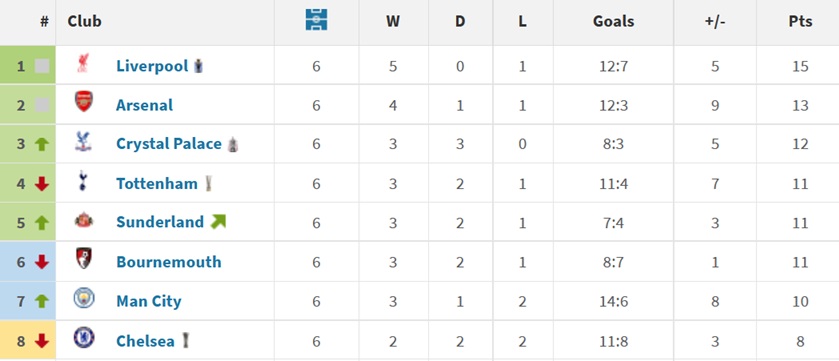
ABOVE: Early Premier League standings, from Transfermarkt
Meanwhile, completing the league’s top eight heading into Gameweek 7 were Arsenal, Crystal Palace, Tottenham Hotspur, Sunderland and Bournemouth.
The Gunners lost two of their three concluding friendlies as Palace won just one of five – although winning the Community Shield on penalties certainly didn’t look like a draw!
Newly-promoted Sunderland lost five of their final six pre-season matches, but defied statistics to eventually finish in the top half.
Then again, most of the bad summers were maintained. Everton found themselves ninth after Gameweek 6, but Newcastle United, Nottingham Forest, Burnley and Wolverhampton Wanderers were 15th, 17th, 19th and 20th.
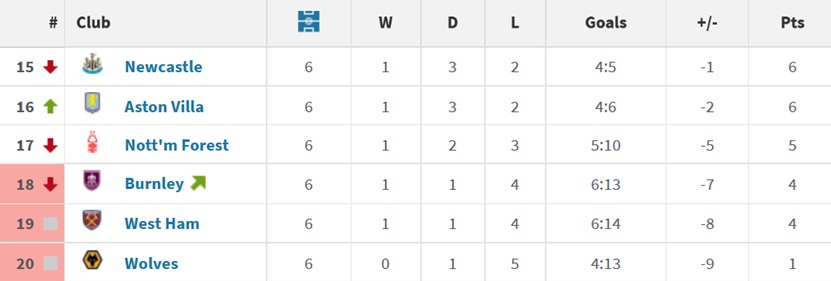
The Magpies’ summer was overshadowed by Alexander Isak’s antics, while five of Forest’s seven friendlies ended 0-0. They beat Brentford on the opening day, but that was it until Gameweek 11.
Apart from consecutive wins in Gameweeks 8 and 9, Burnley only won on two other occasions. This was worsened by Wolves, who registered a shocking two points from their initial 18 encounters.
PLAYERS IN PRE-SEASON
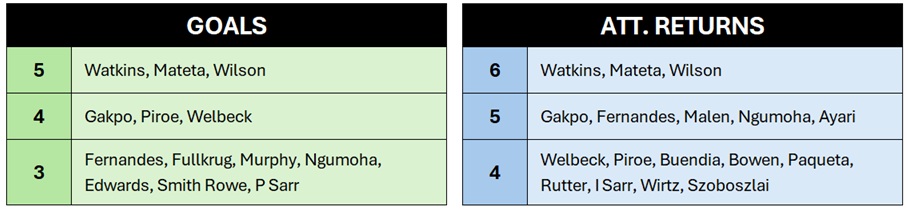
Individually, leading the way were Ollie Watkins, Jean-Philippe Mateta and Harry Wilson, each grabbing five goals plus an assist.
Although the then-Fulham winger went on to have a great FPL campaign, it took months to kick into gear. Only Mateta carried this form over by adding a Gameweek 8 hat-trick to two early goals. As for Watkins, he provided one attacking return throughout his first 13 matches.
Villa teammates Emiliano Buendia and Donyell Malen enjoyed pre-season, but neither started the first couple and the latter departed in January, just like Hammers duo Niclas Füllkrug and Lucas Paqueta. At least the Brazilian joined Jarrod Bowen in beginning strongly.
Other non-reliable starters included Jacob Murphy, Emile Smith Rowe and Marcus Edwards, who didn’t make an XI until Christmas. Leeds United’s Joël Piroe featured in only two overall lineups.
Elsewhere, Bukayo Saka‘s Gameweek 2 goal preceded a brief hamstring absence, whereas Pape Matar Sarr assisted on the opening day and scored in Gameweek 4, before losing his place.
Joining Watkins and Füllkrug as the main disappointments were Danny Welbeck (no goals in his first five), Tijani Reijnders (peaked at Gameweek 1) and £116 million arrival Florian Wirtz (nothing until Gameweek 14).
Speaking of Liverpool, Dominik Szoboszlai scored a fantastic August free-kick against Arsenal. But that was the Hungarian’s only attacking return in his first eight. Cody Gakpo netted on night one and assisted twice in Gameweek 2, yet it became a term of good underlying stats ruined by a poor conversion rate.
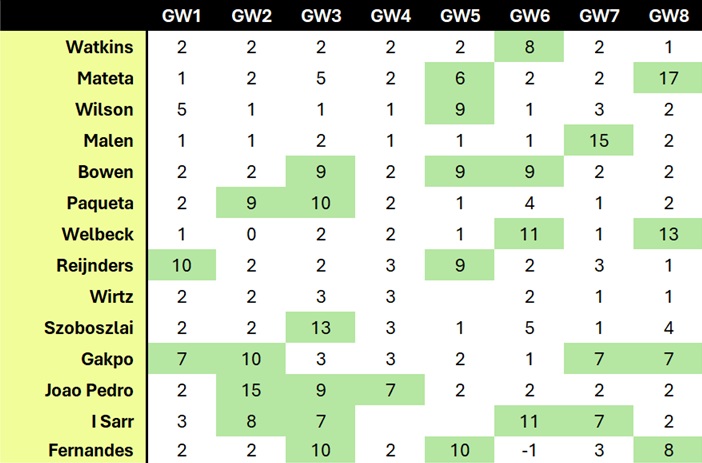
Still, some accompanied Gakpo, Bowen and Mateta in doing well. Joao Pedro – two goals from two friendlies – struck twice and assisted three others between Gameweeks 2 and 4, to ensure his early FPL ownership reached eight million.
Ismaila Sarr scored twice in the original three, while Bruno Fernandes continued his five summer involvements by setting a new Premier League assists record and finishing on 235 points.
On the other hand, some of FPL’s best players did so despite a quiet warm-up. Antoine Semenyo did very little in pre-season, but an opening-night Anfield brace kicked off his incredible 17-goal campaign, one that took him to Manchester City.
Brentford’s Igor Thiago bagged 11 goals in a 13-match burst. FPL legend Mohamed Salah found himself on multiple goals and assists by the end of Gameweek 5, as Enzo Fernandez secured double-digit hauls in Gameweeks 2 and 3.
FINAL THOUGHTS

We’ve seen examples of both momentum continuing and trending the opposite way, but a couple of general observations emerged.
Good team form is a mixed bag, but bad summers tend to keep going. Keep an eye on those and stay away.
A lot of player ‘form’ meant almost nothing, so try to avoid being tempted by new sensations. Ideally, your initial squad will be based on past reliability and upcoming fixtures.
Of course, pre-season is still useful for plenty of other things. Pre-season minutes, especially in the final kickabouts, are usually a good way of predicting line-ups for Gameweek 1. Useful £4.0m defenders may present themselves over the summer. Friendlies are handy for monitoring formations and tactics, especially for incoming managers; see Oliver Glasner’s use of wing-backs at Nottingham Forest, for instance. Clues over penalty takers may also emerge in these exhibition matches.
Plenty of reasons to pay attention to what’s happening in pre-season, then – just look beyond the contextless ‘goals and assists’ column for more meaningful insights.


