







Earlier this season I took a look at the predictive value of different statistics in Fantasy Football. My first article on the subject can be found here. But so far a lot of the discussion, such as Balders flagging up of 11tengen11’s analysis on the predictive value of stats, has focused on teams rather than specific players. For this latest article I thought I would look at how statistics can be used to predict returns for players, specifically forwards and midfielders that have played a minimum of 270 minutes for the past four complete seasons (2011/12 to 14/15)
Total stats
Firstly we are usually interested in predicting goals for the next six Gameweeks using the data we have at the current point in time:
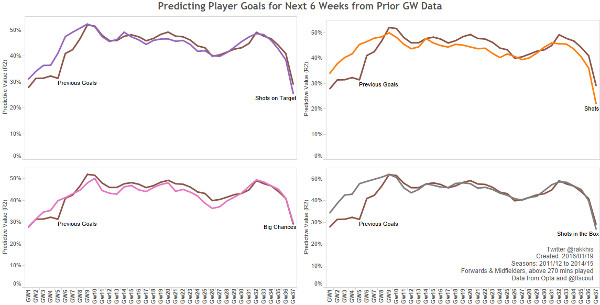
Most of the statistics provide a 40-50% predictor of the player goals for the next six Gameweeks. But this is bad news for stat-heads and good news for casuals because the best indicator of goalscoring remains goals scored already, rather than underlying statistics such as shots on target.
Last 4 Gameweeks data
How about the more recent data? Are the last four Gameweeks a better indicator of form and therefore a better predictor?
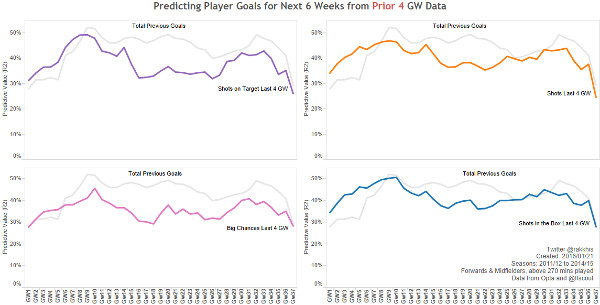
Actually this is where stat heads may be able to steal a march over casuals, as the last four Gameweeks’ statistics such as shots on target and big chances is a surprisingly good predictor for player goals for the next six Gameweeks. But it is still not better than goals scored.
Combining stats
How about combining the stats? Can using a variety of statistics together prove a better predictor?
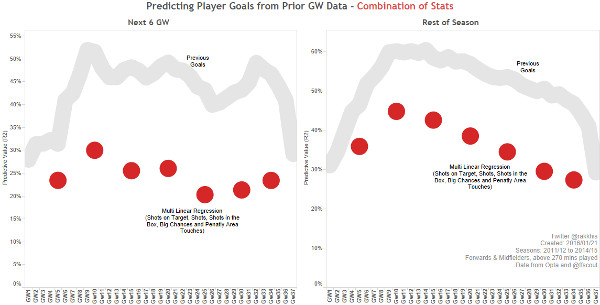
Building a complex mode with high predictive power seems quite difficult, using a technique called multiple linear regression (https://en.wikipedia.org/wiki/General_linear_model) which enables you to relate multiple independent variables to a single dependant variable. In this case I used: shots on target, shots, shots in the box, big chances and penalty area touches to attempt to predict goals scored in the next six Gameweeks and also the rest of the season.
As you can see unfortunately considering multiple factors may actually lead to a worse prediction than simply a single statistic.
Fixtures
How about using tried and true fixtures? Intuitively it seems like they have not worked so well this season but experienced players will tell you that form usually follows fixtures. In Gameweek’s 23 and 24 Everton striker Romelu Lukaku is predicted to score goals at home to Swansea and Newcastle, even though he goes into the fixture on the back of a poor run of form. But are Lukaku backers right to anticipate a points haul?
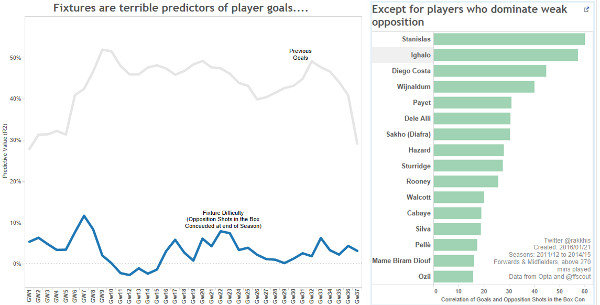
It seems not. In fact it is quite frankly amazing how bad fixtures are for predicting goals. I used the end of season shots in the box conceded as a proxy here for fixture difficulty. The results are clear: as a general rule fixtures are terrible at predicting goals, much worse than simply past goals scored for a player. However, for the players shown on the right it is worth getting them in or keeping them or captaining for a particularly easy set of fixtures.
Assists
How about assists? It feels like Mesut Ozil and Dimitri Payet have encouraged a return to old school midfielders for assists rather than goals type of play.
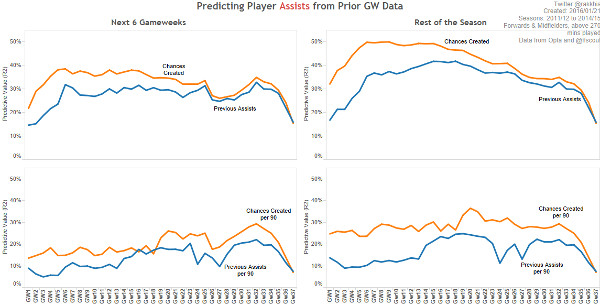
Assists are harder to predict than goals but here at least the manager who looks at chances created has an edge over simply previous assists scored in the season.
Putting the stats to the test in Gameweek 23
A good test perhaps is the next set of fixtures. Taking goals scored over the last four weeks Jermaine Defoe with five goals, Wayne Rooney on four and Sergio Aguero and Patrick van Aanholt with three apiece are the form strikers. If goals scored is the best predictor of more goals then we should expect one or more of these strikers to do well in Gameweek 23.
Taking big chances created over the last four weeks as an indicator Rooney (4), Aguero (3) and Defoe (3) also do well, however this form of data also adds West Ham’s Michail Antonio (4) and Norwich’s Dieurmerci Mbkani (4) to the list. Harry Kane, Olivier Giroud and Georginio Wijnaldum on three big chances each are also predicted to do well according to this form of data.
If Antonio, Mbkani, Kane, Wijnaldum and Giroud do well in Gameweek 23 then perhaps big chances should be given more credence as a predictor.
Finally, let’s take a look at the form players in terms of shots on targets over the last four Gameweeks. Once again Defoe (8) and Rooney (7) do well. But also riding high in this form of data are Newcastle’s Alexsandar Mitrovic (8) and Wjnaldum (7) as well as Kane (7). If the Magpies duo and Kane prosper this Gameweek then perhaps it is time to consider shots on target as a bigger predictor of points.
Conclusion
Hopefully this doesn’t discourage you from looking at the statistics. In fact the aim really is to consider more complex models than the simple stats tables and to test those models for their predictive value against historical data. If you want to save some time though don’t feel guilty about simply relying on the top goals scorers for the season. All eyes will be on Rooney, Defoe, Van Aanholt and Aguero in particular in Gameweek 23.
Extra graphs
Some graphs for those who are interested:
Total stats predictive value for the rest of season at a given Gameweek: graph
Per 90 stats for predicting player goals for the next 6 Gameweeks: graph
Per 90 stats for predicting player goals for the rest of the season: graph


