


With ten Gameweeks remaining this season we are entering that time of the year when no one wants to play the teams scrapping for their lives in the relegation battle. Perhaps perpetuated by the miraculous escapes by Sunderland and Wigan in recent seasons, there seems to be a theory that the better fixtures in the run-in are those against teams with less to play for – the mid-table teams for whom European places are out of reach and who have accumulated enough points to consider relegation unlikely. In past seasons some of my own transfers have been guided by this theory.
There are, however, arguments against this theory. Players are professionals and they hate losing. In some cases, teams play better when not under pressure. There is also a financial incentive to finish higher in mid-table than lower, due to the way in which Premier League prize money is distributed. In this article I examine some basic historical data to test the theory that relegation battlers become a difficult fixture during the run-in.
Method
My first step was to take the Premiership standings in early March (with around 28 games played by each team on average) in each of the past ten seasons and classify teams into three categories:
- Top 7 (positions 1-7),
- Mid-table (positions 8-14), and
- Relegation Battlers (positions 15-20).
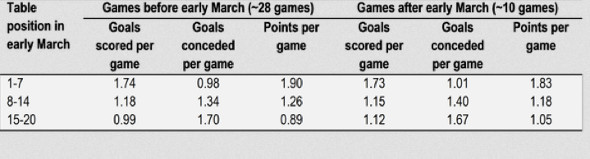
I then used the final standings for each season to assess how those teams performed over the run-in. The table below compares performance over the run-in with performance over the earlier part of the season on average over the past ten seasons for each of these three categories.
Results
Table 1: Team performance by position in early March
This table can also be viewed here.
Relegation battlers pick up more points during the run in.
The average points per game earned by relegation battlers increases from 0.89 before early March by 17 per cent to 1.05 over the run-in. There is only one season over the past ten in which relegation battlers have not improved their results after early March. That year is 2009-10, thanks largely to Portsmouth’s horrendous points tally of zero over the final ten games of that season. This performance improvement is not a fluke of the data sample. A t-test finds that the difference in averages is statistically significant even at the 99 per cent confidence level. The relegation battlers appear to take the extra points from both Top 7 and Mid-table teams, whose average points outputs drop from 1.90 to 1.83 and 1.26 to 1.18, respectively, over the latter part of the season.
Relegation battlers on the attack
The average number of goals scored per game by relegation battlers increases from 0.99 before early March by 13 per cent to 1.12 over the run-in. This may not sound like much, but, again, a statistical test finds that it’s not a fluke of the data sample. In only one of the past ten seasons has the goal output for relegation battlers decreased after early March. The brunt of this additional goal output seems to be borne mostly by Mid-table teams whose rate of goals conceded increases from 1.34 to 1.40 per game after early March.
The additional goals do not appear to come at the cost of a leakier defence
The average goals conceded per game by relegation battlers remains similar over the final ten games (1.67) when compared to the first 28 games (1.70).
But, do relegation battlers perform better than mid table teams over the run in?
The short answer is no. Although relegation battlers improve after early March, they match Mid-table teams only on goal output (1.12 compared to 1.15 goals per game). They remain worse than mid-table teams in terms of points accumulated (1.05 compared to 1.18 points per game) and goals conceded (1.67 compared to 1.40 goals per game).
As an aside, there appears to be an 8th place hoodoo. Somewhat surprisingly, the team in 8th position in early March performs worse than any other team over the run in. Only twice in ten seasons has this team scored more than ten points over the final ten matches. Last season it was Newcastle. The season before, it was Swansea. Owners of Stoke City fantasy assets beware.
Conclusion
The theory that we should abandon all mid-table assets in favour of relegation battlers does not hold water, at least in terms of averages. The data do suggest there will be an upturn in goal output for attacking players at clubs battling relegation and there may be some bargains on offer as a result. Who those bargains will be remains to be seen. Outside of already popular picks Danny Ings and Charlie Austin, who will rise to the occasion? Dame N’Doye? Jermain Defoe? Christian Benteke? There is some evidence that mid table teams tend to go off the boil to an extent after early March, but not to a dramatic extent. They still perform better than relegation battlers, on average. No need to offload Jason Puncheon or Saido Berahino on account of their teams being in mid-table, then.
The historical averages don’t call for any dramatic changes to the fixture difficulties on the season ticker. The prospect of our defenders getting a clean sheet against a relegation battler may be slightly diminished over the run in. There may also be a slightly greater chance of attacking returns against mid-table teams. I, for one, won’t be taking as much notice of this issue as I have in previous seasons based on the evidence above. But, for those that continue to subscribe to the theory that mid-table teams ‘check out’, it is worth noting that QPR are set to play five of the current mid-table teams on the run in – three of them at home (cpl, EVE, wba, WHM, NEW). Sunderland (whm, NEW, CPL, sto, eve) and Liverpool (swa, NEW, wba, CPL, sto) also play five, while Arsenal (WHM, new, SWA, WBA) and Leicester (WHM, wba, SWA, NEW) each play four mid-table teams with three of those games on home soil. Hull City face a tough schedule and play only two of the mid-table teams (swa, cpl).
Finally, it is well worth noting that the marginal differences in the averages analysed in this article are dwarfed by the variation in the underlying data. In 2011-12, Wigan picked up 22 points from their final ten matches to move from 20th up to 15th in the table. In contrast, Portsmouth in 2009-10 was five points adrift of 17th place heading into the final ten games, but failed to pick up a single point over the remainder of the season. In 2008-09, Hull City and Spurs were 12th and 13th in early March. Over the remainder of the season, Spurs accumulated 20 points, while Hull picked up only three. The real gains from a fantasy perspective will, as always, be derived from catching the waves of form at the right time.


