







Making a welcome return to the site, former Fantasy Premier League (FPL) champion Simon March examines whether collecting as many transfers as possible is truly the best strategy.

In its evolution, arguably the most dramatic change ever made to FPL was the introduction of rolling transfers.
So profound is the difference a manager can make to their team using two transfers, instead of just one at a time. Therefore, the ability to stack up to five of them, around since 2024/25, should have revolutionised the game completely.
As sitcom TV shrink Frasier Crane once said: “If less is more, imagine how much more more would be!”
By this logic, what should have followed was a sort of overarching ‘meta-strategy’ for optimum play. Where success is heavily influenced by how often a manager can accrue five transfers and how well they can plan for the interim periods of inactivity.
But now, in the second season of this rule, there’s reason to question whether accruing maximum – or near maximum – transfers is even the best strategy.
Let’s consider the pros and cons of rolling them over and if there is, in fact, an optimum number of transfers to hold at any given time.
Should FPL managers seek to bank five transfers?
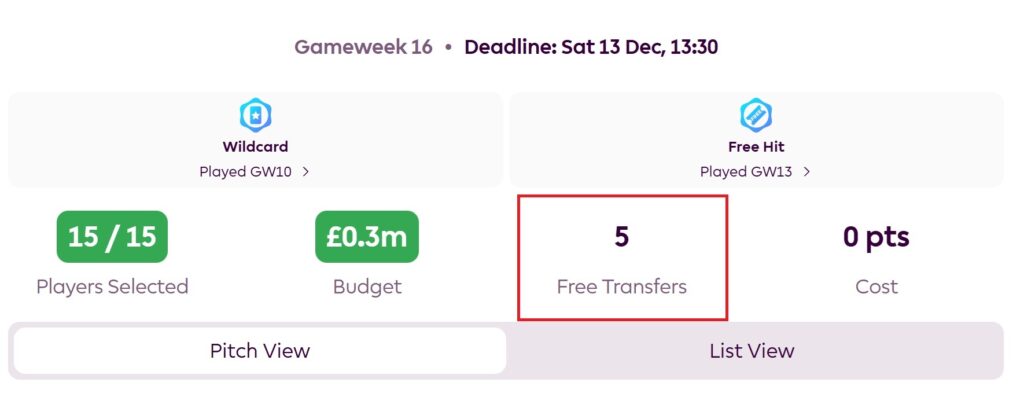
From a purely rational, strategic perspective, it will always be better to have more transfers available, rather than fewer. It gives you a wider range of options.
Five are enough to renovate a third of a squad, which is particularly useful ahead of big fixture swings, blanks and doubles. There aren’t many FPL problems that couldn’t be solved with these.
However, the first issue when it comes to banking three or more transfers is the sacrifice of not making any changes for several Gameweeks.
Even with the best planning, there’ll rarely be a long stretch of time where your squad couldn’t be improved by making at least one switch. Committing to a rollover means you’ll always be surrendering some level of advantage to the more aggressive, proactive managers.
Injuries and suspensions come up along the way. That’s why a very patient transfer strategy might require more strength in depth. 15 playable assets, no cheap ‘dead spots’ in the squad, but less money invested in the starting XI.
Good things come to those who wait

It’s worth mentioning at this point that, while you will find excellent FPL managers across the whole stylistic spectrum of aggressive to disciplined play, when you look at those who rank consistently high, there’s a noticeable tendency towards having a patient approach.
Should a correlation indeed exist between patience and FPL success, it wouldn’t be too surprising.
Social scientists and performance analysts have long pointed towards the ability to delay gratification and exercise patience as a key characteristic of successful people in general.
And we’ve seen plenty of players go through long stretches of blanks before suddenly scoring well. Names like Igor Thiago (£7.0m), Harry Wilson (£6.0m) and Dominik Szoboszlai (£6.7m) are fairly recent examples of eventually rewarding their owners.
Even when the underlying data looks extremely positive, it often takes a while for such numbers to materialise into points. Benefiting from those when they arrive is typically the purview of the patient (or lucky).
Those who are disciplined with transfers may logically be more rigorous planners. Or show a willingness to forgo short-term points in the interests of investing in more robust, longer-term assets.
Thus, it might be difficult to ascertain whether patience, rigour or a tendency to plan ahead is the key characteristic for success. But we can at least say that the elite FPL managers like to accrue transfers and maybe such an attribute is why they’re the very best.
How many banked transfers are optimal?
If we accept that rolling transfers over is a positive in FPL, then the next question asks what the ideal number is. Is it simply as many as possible? Or is there a limit to this principle?
I’d argue that the optimum number to have accrued at any given time, notwithstanding blank and double Gameweeks, is two or three.
It’s the middle ground between using one at a time, which tends to be very limiting, and the detrimental opportunity cost of not making any changes for four-to-five rounds.
Less really can be more

But there is another potential factor that might work against storing maximum transfers: the possibly negative psychological effect that an abundance of transfers can have on decision-making.
In FPL, as in life, when we have limited resources, we tend to be more rigorous and disciplined than when there is an abundance. Psychologists refer to this as a ‘scarcity mindset’ or ‘scarcity mentality’. We put greater value on scarce resources and, consequently, become more focused and motivated on getting the maximum value out of them.
On the other hand, when we have too many resources available to us, there’s a ‘too-much-of-a-good-thing’ effect. We focus less, are less rigorous when making decisions, and take bigger risks. Sometimes, we may experience the mentally overwhelming effect of all these options, the ‘paradox of choice’, which can also be harmful when lucid and effective calls need making.
We see evidence of these effects in all sorts of sectors. For example, startup businesses tend to perform very efficiently and effectively until the moment when they secure some large external funding. Or, in football, we often see teams receive a red card and subsequently outperform their opponent, despite having fewer players.
How effectively did you use those five free Africa Cup of Nations (AFCON) transfers from December? The evidence is largely anecdotal but, going by common themes within the FPL community, there is a definite sense that many of these transfers were wasted on punts and short-term options.
Speaking for myself, I know I could have used those transfers better. Had I not received so many, there’s a decent chance that I would have been smarter.
Then again, it’s not quite the same thing because we were all given this AFCON opportunity, rather than accruing the transfers ourselves. In such circumstances, people tend to be more experimental and risk-inviting (see ‘The House Money Effect’). The principle, however, may still be instructive.
Summary

In both life and FPL, more resources do not necessarily equal better outcomes. Whatever the arena, the more we think we have, the faster they tend to run out.
Patience is a demonstrable virtue in FPL. But on both strategic and psychological levels, our transfer decision-making might be best served by having just enough transfers to allow for flexibility, yet not so many that we become complacent or reckless.
With all this in mind, I propose that collecting two or three keeps us rigorous, efficient and deliberate in our execution. Whereas, when on four or five, we risk becoming more attracted to short-term punts. While such aggressive play can, of course, pay off, it invites more problems further down the line.
This is not to say that, once we’ve banked three of them, we should start using them just for the sake of it, to maintain that number. But we should be wary of thinking that storing transfers gives us an automatic advantage when there are reasons to believe that the opposite might be true.
Storing this middle amount strikes the right balance between flexibility and opportunity cost. This may benefit managers further by helping them achieve the best mindset for finalising decisions.


