








The start of the 2026 FIFA World Cup is just days away now – and managers are starting to get closer to finalising their Fantasy teams for the official FIFA game.
In this article, FPL Meerkat shares his current draft, chip strategy and thoughts around the ‘Scouting Bonus’.
- READ MORE: FIFA World Cup Fantasy 2026: 150 of the best, worst + funniest team names
- READ MORE: How to play the FIFA World Cup Fantasy 2026 game
I love Fantasy Football international tournaments, short-term, fast-paced games that reward players for staying active.
Overview

So, World Cup Fantasy brings back the captaincy rules that Club World Cup Fantasy players will be very familiar with.
You can pick a new captain at any point, as long as the new captain hasn’t played yet.
This means, theoretically, you can have 15 different captains, if all your players play in different matches.
I have tried to capitalise on this. Therefore, there are only four teams I have doubled up on and no nation I own three assets from.
When picking players, I factor in these things:
- They are nailed for their team
- For attackers, they are the talisman for their team and take the majority of set pieces
- For defenders, they have a high % chance of a clean sheet
- They are in good form coming into the tournament
Something else important to factor in with my selections: I am committing to a Wildcard in Round 3. That means I am only considering players with good fixtures in the first two Rounds (aka Matchdays/Gameweeks).
Goalkeepers

You’ll likely be aware by now that World Cup Fantasy offers something called Scouting Bonus, whereby if a player has 5% or lower ownership and returns four or more points, they gain an additional two points. So, it makes perfect sense to utilise this in the goalkeeper position.
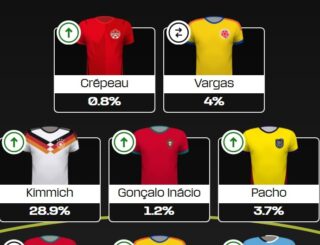
Both Camilo Vargas ($4.3m) and Maxime Crepeau ($4.0m) have excellent fixtures in the first two Rounds, boasting some of the highest clean sheet odds in opposite matchdays. We can only gain one goalkeeper’s points in a given Round, so going cheap means I’m not wasting funds on the bench.
I also like Norway’s Orjan Nyland ($4.2m) and Ecuador’s Hernan Galindez ($4.2m), as they both fit this criteria. Unfortunately, Switzerland’s Gregor Kobel ($4.7m) has now crept over 5% ownership.
Defenders

Again, the main strategy here is to target the best defences. Clean sheets awarding five points is the best route into consistent points here.
However, while Germany and Spain boast some of the best defences in the tournament and have favourable fixtures in the first two Rounds, none of their nailed-on defenders are below 5% ownership.
So, I’ve gone with Joshua Kimmich ($5.5m) and Marc Cucurella ($5.1m) as safe options with huge upsides. Kimmich takes a good portion of set pieces for Germany and may even be second-choice penalty taker, whilst Cucurella loves to get high up the pitch. He’s not the most prolific for Spain but he’s my favourite from their backline. Aymeric Laporte ($5.5m) is currently 4.9% owned but if he manages to stay below 5%, I may switch to him.
The other three defenders in my team, two of whom are Willian Pacho ($4.4m) and Mathias Olivera ($4.3m), all fit into the same category as the goalkeepers. They are cheap, fairly secure players operating in solid defences. Gonçalo Inacio ($4.6m) has some competition from Renato Veiga ($4.3m) for his position, so he is the likeliest to change, but I’m hopeful he will start Portugal’s final friendly against Nigeria. If this is not the case, Nuno Mendes ($5.8m) will need to find some way into my squad.
The idea is to get easy nine-pointers from these players: +5 for a clean sheet and +2 for Scouting Bonus.
I’m not really considering alternative routes to points with such cheap players.
Midfielders


