





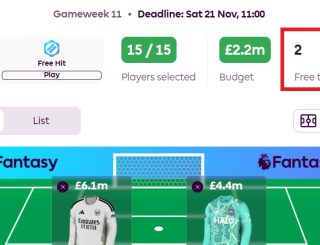

Making a welcome return to the site, former Fantasy Premier League (FPL) champion Simon March looks into free transfer usage – and why rolling and amassing them can open up new opportunities.

Have you ever noticed how, at any given time, the most successful FPL managers always seem to have lots of transfers available?
It’s no secret that rolling and using two free transfers, rather than one at a time, was a core aspect of good FPL practice for years.
However, since the ability to roll five transfers was introduced in the 2024/25 season, the meta seems to have changed. Aggressive play, in general, now sits below patient play in efficacy – or at least, so it seems.
But is rolling transfers the cause of good FPL management or merely a symptom? Has the ability to delay transfers for a more prolonged period revealed something new to us that we didn’t see during the ‘use it or lose it’ years? Is there anything particularly beneficial about the act of banking transfers, practically or even psychologically? I’ll address these questions in this week’s article.
Effect and Cause

Before we dig in, we must consider the causal direction here because it’s very possible that good managers bank transfers because, being good managers, they’ve already picked good players, thus negating the need to use transfers.
It could also be that they’ve been luckier with injuries or suspensions and have had less need to use transfers on that basis.
We can’t rule either of these possibilities out, but they’re unlikely to explain the whole phenomenon and, while this is anecdotal (much of this, I admit, is anecdotal), a casual observation of elite managers shows that they often make the same selection mistakes that mere mortal managers do.
Roll With It

As mentioned, there are obvious, tangible benefits that come from rolling transfers. It has always been the case that you can do much more with multiple transfers than just one, largely because it broadens your options. You can shift funds around and get closer to your optimum target than you can when your options are limited to ‘like-for-like’ players in the same classification and budget bracket as the one you are removing.
If this logic holds for two transfers, then it’s reasonable to think that it also applies to three transfers and so on. The net benefit might not grow exponentially, or even linearly, the more transfers you use, but it definitely offers more options, which is generally a good thing.
The benefits of rolling transfers don’t stop there, however. If you have 3-5 transfers banked, you are, in a sense, playing a deluxe version of the game with special privileges that others do not have. For example, you can afford to make an early transfer to avoid a price rise and not have to worry as much about whether the player picks up an injury. You can take a short-term punt on a player with one or two good fixtures or ditch a premium player temporarily if they are facing a couple of bad fixtures. If you have enough transfers, you could target the week before you play your Wildcard and use them all in a ‘mini Free Hit’, maximising your potential return on some good that week.
The options go on and on but, simply put, transfers are not just transfers when you have a lot of them; they become something more.
Blank Space

One consequence of being able to roll to five free transfers is that we have the option, at least, to be more patient with the players we choose. When we had to make at least one transfer every week or ‘burn a transfer’, an underperforming player would be a prime target for that transfer.
Now that we can go a whole five Gameweeks without using or losing a transfer, the option to be more patient is more viable. It has exposed something that we probably didn’t pay much attention to before, which is that even the best players tend to blank quite a lot of the time.
Last season, the top seven highest-scoring midfielders or forwards blanked, on average, almost 40% of the time. Even the top-of-the-top scorers, Erling Haaland (£15.8m) and Bruno Fernandes (£11.6m), blanked in 37% and 29% of the matches they appeared in.
What this reveals is that exercising patience with certain blanking players may well be a better strategy than constantly shifting between them.
If so, a consequence, intended or otherwise, of banking transfers is that it gives ‘regression toward the mean’ a chance to work in these managers’ favour, rather than against them. This could also help to negate any opportunity cost incurred from not making transfers for a prolonged period.
Rolling in the Deep

When accruing transfers, it helps to have a good squad and a bench that you can go to when necessary. Building a squad with reliable players is only the first part of that initiative; a willingness to actually use ‘bench players’ is the other.
Does this mean that, occasionally, a player with sub-optimal conditions will be required to play in a fixture? Yes, probably. But we have, at this point, seen enough instances of players delivering despite sub-optimal conditions that we perhaps shouldn’t be as concerned by this as we tend to be.
It’s still not ideal, though, is it? No, but the benefits likely outweigh the negatives, and this is another reason why good managers accrue transfers; strength in depth and a willingness to utilise that depth means that all transfers are made from a position of strength, rather than necessity.
When multiple transfers are available, and no transfer is necessary, almost all transfers and transfer scenarios become optional. In other words, if you only ever have to make ‘luxury transfers’, you are gaining a huge advantage over those making more forced moves with narrower options.
Summary

If it seems like the best managers always have plenty of transfers, then there may be good reasons for that. Rolling transfers creates options, helps to avoid spurious bandwagons and gives good players an opportunity to find their form. All of this, it seems, is built on a foundation of strength in squad depth and it very much feels, particularly in the absence of many viable premium options and the presence of relatively high-floor, low cost defenders, that FPL is becoming much more of a ‘squad game’ than a ‘maximising the first XI’ game.
FPL is also a game that is increasingly rewarding patience over aggression when it comes to making transfers. The more transfers we bank, the more strategic options become available to us and the more exclusive those strategic options become. The third, fourth and fifth transfers banked have significantly more utility than the first transfer. We tend to focus a great deal on finding differential players, while often overlooking the fact that it is differential strategies that are sometimes more profitable.
While there is, of course, an opportunity cost concern about going a long time without making a transfer and, I would argue, a psychological risk that comes with accruing abundant resources (we, as humans, tend to become less efficient the more we have of something), it remains that managers who bank transfers are playing the game with various advantages that are unavailable to managers following a more aggressive approach. Whether one approach will decisively win out over the other in the long run remains to be seen but, for now, signs point to the patient approach being the most effective.


