






Sir Alex Ferguson’s decision to field a 4-3-3 at home to Fulham came as a shock to many last weekend, given that Wayne Rooney’s suspension looked like offering Dimitar Berbatov the chance to partner Javier Hernandez up front for the league leaders. With the upcoming Champions League Quarter Final second leg against Chelsea undoubtedly in mind, Fergie instead opted to leave Little Pea out altogether, much to the chagrin of the 42,000 Fantasy Managers who drafted the Mexican in on the back of Rooney’s missing gameweek.
The Bulgarian was flanked by Nani and Antonio Valencia, with this match only the third time (GW1, 30 & 32) both wingers have started in the league together this term, a result of Valencia’s injury lay-off. Here’s a look at a game that saw United record a league win for the twelfth time in succession at Old Trafford:
Width
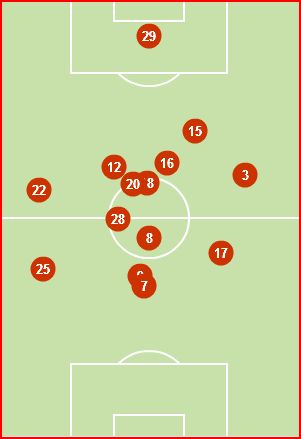
So how did the wingers fare in a different system? A look at these Average Position maps taken from the GW30 Bolton game (where United played 4-4-2) and the Fulham match highlights not so much the extra width the formation afforded the team last Saturday, but how seldom, in comparison, United really used the flanks in their match against the Trotters.
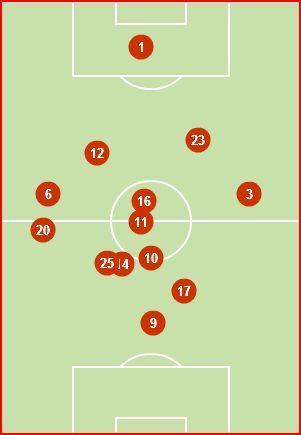
Against Bolton (left) both Valencia (25) and Nani (17) played too centrally, with Nani’s role, in particular, resembling that of a second striker, given how deep Wayne Rooney (10) played.
Against Fulham (right) the map looks more appropriate for each player’s position. Playing as an inside-out winger on the left means Nani will always have a tendency to drift inside but there’s a far better balance here. Valencia’s positioning also looks far more like that of a conventional right-winger. There’s also a definite similarity between Anderson (8) and Rooney’s role in the Bolton game, but without the congestion in the middle.
Passing
In the Bolton game, both Nani and Valencia made more passes to Wayne Rooney than they did to any other United player, on 14 and 8 occasions respectively. A result of their positioning or of “The Big Man” dropping deep for the ball and pulling rank? Hard to be definitive, really, but it’s interesting that, against Fulham, Valencia Top-Passed (8 times) to both Anderson and John O’Shea, while Nani made the same number of Passes to Patrice Evra (7 times) as he did to Anderson, confirmation of the fact that the pair linked with their full-backs as much as their attack-minded team mates, another example of United finding a better balance.
With more space and perhaps more scope to influence the game, it’s also worth noting that between them, Nani and Valencia made 9 Successful Dribbles against Fulham (five and four, respectively) but made just 3 against Fulham (three and zero).
These Passing Heat Maps taken from the two games illustrate this:
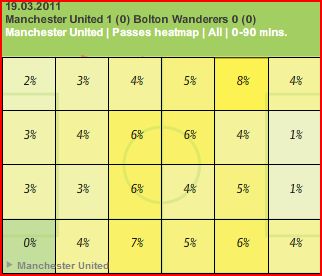
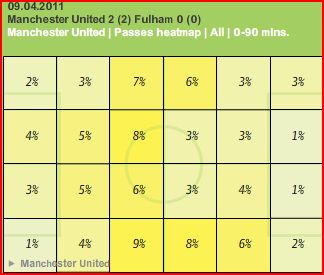
The percentages out wide in the middle third of the pitch are revealing. Against Bolton, United used this area of the left flank for 9% (4 +5) of all passes and the right flank for 12% (7 + 5) of all passes. Saturday saw a big leap, with 13% on the left (7 + 6) and 17% on the right (9 + 8). United made virtually the same number of passes in both games (520 against Bolton, 529 against Fulham) but significantly increased their passing in these areas from 21% to 30%.
No doubt that Fergie will move back to 4-4-2 when it matters most, with Rooney offering more attacking intent than Anderson and Hernandez’s movement far superior to that of the less industrious Berbatov. As an exercise in testing out his options, however, Saturday certainly reminded Fergie there’s plenty of positive alternatives available for those occasions in the season where he has to do without the services of Rooney, for whatever reason that may be.


