


If you haven’t already read Neale’s excellent article on ‘the winners and losers on the FPL Bonus Points System’ read that first.
Going by position, he explains how different types of players can benefit from the Bonus Points System (BPS), who gains most in a low-scoring match, and why forwards can be completely anonymous, get one goal, and walk away with the maximum three bonus points.
This three-part article will go into more depth: from understanding how Opta record statistics – how they ‘see’ a match, together with examples so you know what to look out for; to examining compound BPS events, and revealing the BPS trends over the last five seasons.
But to start with, let’s take a look back at how the BPS came into being.
The Evolution of Bonus Points

Bonus points have been an integral part of FPL since its launch in 2002.
Back then it was left to the whims of the Press Association to award three points to the player, or players, who were adjudged to have made the most significant contributions in a game.
But the subjective opinion of the ‘man in the stand’ was not the only way that bonus points used to be awarded – there were attempts to recognise excellent individual performances using objective stats long before Opta became entwined with FPL in 2013/14.
The 2005/06 season marked the first break from the Press Association with the introduction of the Actim Index bonus (although it’s compiled and distributed by PA Sport, a subsidiary of the Press Association):

The idea of using video analysis to measure both a player’s positive and negative actions is essentially the same as it is today. There was one problem, however, with the short-lived Actim Index as you can see from the image below:

Bonus points weren’t allocated until days after the match had finished! Can you imagine the uproar if managers had to wait that long for bonus points now?
If anything, things got slightly worse the following year as the rules were tweaked to say that Actim Index bonus points would be awarded within 48 hours of the last match of the Gameweek.
It will come as no surprise, then, that the Press Association were brought back for the 2007/08 season and bonus points were awarded an hour after the concluding match each day.

As an aside, for those two years in which the Actim Index was used to calculate the bonus points, ‘second assists’ were also counted as an FPL assist. In other words, players who ‘assisted the assister’ were rewarded in those days.

Before we leave the Actim Index behind, it’s notable that the record bonus points tally in a season was set during its era. Cesc Fàbregas amassed a whopping 54 bonus points in 2006/07, an average of 1.8 for each of the 30 matches he started that year.
Although, curiously, Fàbregas did not finish top of the Actim Index itself, that honour went to Didier Drogba.

While Actim’s “complex mathematical formulae” (we’d probably say ‘algorithm’ nowadays) loved Drogba, the Ivorian only picked up 20 bonus points. As Neale pointed out, for a player to be awarded bonus points in a match depends as much on what his team-mates do in the game, as it does with his own underlying statistics.
The ex-professional footballers who formed the Press Association analysts, remained the bearers of bonus points until 2011/12 when the EA Sports Player Performance Index (PPI) took over.
In fact the EA Sports Index was simply the Actim Index rebranded, but this time an objective, unbiased approach was here to stay – the days of the ‘man in the stand’ were officially over.
When reporting on the change back in July 2011, Mark noted that “goalscorers on winning sides are set for regular gains”. Andy (not that Andy but Leicester City-fan Andy) backed him up a couple of weeks later observing that “clean sheets contribute towards a midfielder’s – and even a striker’s Index tally”, which led him to conclude:
All roads, perhaps unsurprisingly, lead to goals then. If a player scores a goal (or even just contributes to it) then their Index score seems likely to beat off other “top performers” across the less significant performance statistics.
Words that echo Neale’s from last March:
The Bonus Points System is, unquestionably, the forward’s friend in its current guise.
But perhaps a key factor behind the reintroduction of a stats-based approach to bonus points was that they would now be awarded “the morning after the match” rather than 48 hours later.
Another (mildly) interesting aside: 2011/12 was also the year Fantasy Football Scout took on the role of ‘The Scout’ for Fantasy Premier League.
The Opta Era

The EA Sports PPI remained in place for a couple of seasons, a period that included the second and third biggest bonus points tallies recorded: in 2012/13 Gareth Bale mustered a half century of performance-related marks and Robin van Persie notched up 49.
The year after those monster hauls it all changed again as Opta embedded itself in Fantasy, and FPL created its own Bonus Points System based on their metrics.
The balance of BPS points was tweaked slightly in the first two seasons but has been unchanged since 2015/16. The value of a save and a successful tackle doubled, while the importance of pass completion was reduced by a third. And successful dribbles weren’t rewarded until the second year of the BPS.
The other crucial change with Opta was a return to bonus points being allocated on the same day. At last we had the speed of the ‘man in the stand’ with the objectivity of statistics.
Opta began collecting real-time football data in 1999 with Euro 2000 the first major tournament to have live player stats available.
Nowadays, they supply an array of data feeds in the form of XML files. As an Opta customer, Fantasy Football Scout receives several of these – and they power the Members area.
But Opta aren’t just concerned with live match data. After the full-time whistle has blown their post-match team takes over, reviewing the game play-by-play. And before an XML file is marked as ‘safe to use’, a second post-match team completes their checks.
So changes in the match data can occur for some time after a game has finished. Only the early kick-offs on a weekend stand any chance of having their checks completed by the time bonus points are added.
Essentially, thorough and exact video analysis takes time. Thankfully Opta’s three-step process ensures that we, as Fantasy managers, don’t have to wait days for our bonus points or for ranks to update. But it does mean there’s the odd occasion when players are short changed.
For instance, following Man United’s victory over Newcastle in Gameweek 25, Harry Maguire narrowly missed out on a BAP.

But, by the time Opta had completed their checks, the centre-back had moved above Daniel James.


An extra CBI and two successful tackles took his BPS tally to 28.
Before disgruntled Maguire owners start petitioning FPL for their ‘missing’ bonus point, it’s worth bearing in mind that Opta’s data collectors are human beings and the Man United v Newcastle game was the last to kick off that day.
It’s completely unrealistic to expect Opta to have reviewed the match, in full, one hour after the final whistle. Bonus points are added while that process is taking place. And, as good as the live data is, there will inevitably be a few differences.
But ultimately, occurrences like this are relatively rare. And whilst it will be frustrating to miss out on the odd point now and again, the at times lightning-quick turnaround between Gameweeks means there’s little wiggle room for FPL to delay adding bonus points and updating ranks – even if that was desirable.
Detective Work

Also, though admirably transparent on how the BPS works, FPL doesn’t give out exact details of which events from the many contained in the Opta match feed are included. The BPS numbers provided on Fantasy Football Scout are very good guesses rather than fact.
But close examination of those match XML feeds has allowed us to make a couple of improvements in the last month – and we believe we now have a perfect match.
For instance, we noticed that successful crosses from free-kicks count as successful open-play crosses. Indeed, only corners are excluded from successful crosses. As a result, ‘Open Play Crosses’ has been replaced by ‘BPS Crosses’ when calculating a player’s BPS score.
And, if comparing our BPS against the numbers reported on FPL, remember that our stats will continue to update after the bonus points have been added. So while they should now be accurate up to that point, there’s no guarantee that they will be after, as seen from the Maguire example above.
The eagle-eyed among you may have noticed that Bruno Fernandes also gained two belated BPS points against Newcastle, thanks to the addition of a successful tackle. Although this change had no impact on bonus.
Compound Events
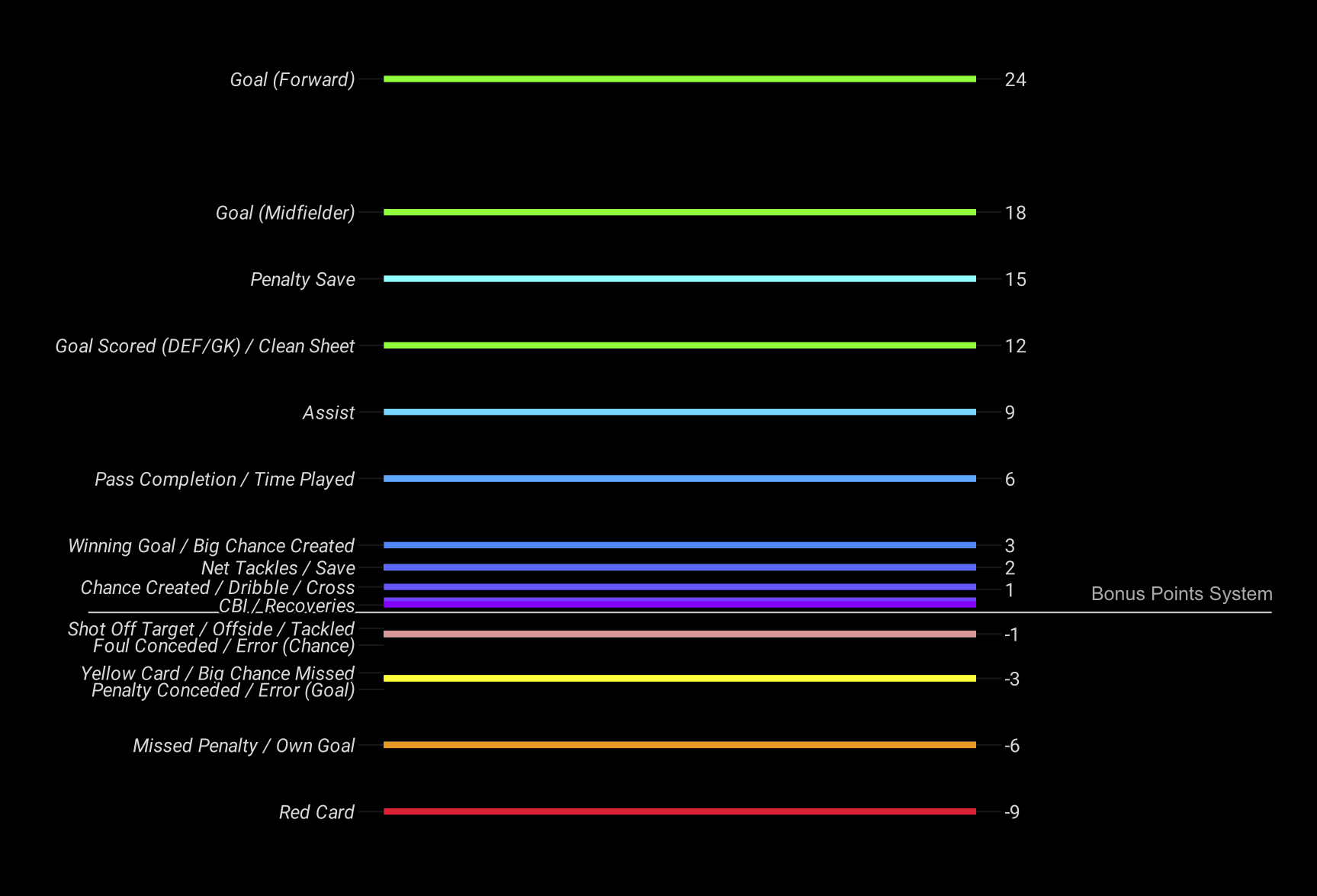
(click on image to enlarge)
The graphic above illustrates the balance between the various elements included in the BPS.
The single event that earns the most BPS points is a forward scoring a goal. If that goal-scoring forward also plays more than 60 minutes they would have a base of 30 BPS, putting them firmly in the mix when the bonus points are dished out.
However, compound events can allow other players to rival those up front.
Depending on the type of goal, playmakers can earn more than just the nine BPS points for the assist: if the chance they create is deemed a big chance they will gain an additional three BPS; most assists are key passes, according to the BPS, so that’s an extra point; and if the assist came from a cross in open-play or a free-kick, that’s yet another point.
So it’s not inconceivable that one assist can earn the creator up to 14 BPS, such as this assist or this one from Trent Alexander-Arnold.
As a defender, if Alexander-Arnold makes it past the hour mark and keeps a clean sheet, he’ll add another 18 BPS points to his tally taking him up to 32. Two better than the goal-scoring forward.
But compound events don’t always enhance BPS scores.
Sticking with an assist example, imagine a player who, when presented with a big chance, hits the post only for a team-mate to knock in the rebound.
In this scenario, the player would be awarded a Fantasy assist, worth nine BPS points, but would lose three BPS points for missing a big chance and one for a shot off target. So his total BPS gained from the assist is really only five.
Essentially, an assist isn’t always just an assist – other factors can enhance or reduce its value. And it’s not just assists that are affected by compound events, as we shall discover in part two of this article.
Key Passes v Chances Created

Assists also highlight a slight discrepancy in the BPS: Opta define a ‘Key Pass’ as:
The final pass or pass-cum-shot leading to the recipient of the ball having an attempt at goal without scoring.
– Opta definition of a Key Pass
So, being pedantic, the BPS rewards ‘Chances Created’ rather than just ‘Key Passes’.
Assists plus Key passes.
– Opta definition of Chances Created
In FPL not all ‘assists’ are ‘chances created’ because the game also includes ‘Fantasy assists’. But, considering only the narrower Opta definition of an assist, they are all chances created too.
When is a pass not a pass? When it’s a cross

Players who put in lots of crosses benefit from a quirk in the BPS.
Not only because successful crosses are rewarded, but also because unsuccessful crosses don’t count as failed passes. Which is important when it comes to pass completion.
A player can earn between two to six BPS for pass completion, depending on their success rate.
This might sound trivial (heck, this whole article might sound trivial!) but, unlike crosses, launches up field and long balls are included in total passes. So a failed long ball will reduce a player’s pass completion percentage whereas a failed cross won’t.
And a cross, as you would expect with Opta, has a specific definition:
A ball played in from wide areas into the box.
– Opta definition of a cross.
Therefore, a player can attempt as many crosses as they want without it affecting their pass completion BPS.
Although, admittedly, the impact isn’t huge.
For a high-volume passer, like Trent Alexander-Arnold, this would only make a difference of about seven per cent. For Lucas Digne closer to nine per cent, and for midfielders such as Pedro Neto and Dwight McNeil nearly 10 per cent.
But we’re still only talking about two BPS at most.
Coming up

In part two of this article we’ll pay a visit to the ‘Opta-metrist’ and learn to see a match like Opta, furthering our understanding of how the events that unfold on a football pitch affect bonus points.
We’ll also look at some of the decisions Opta have made when defining different stats – and how reality doesn’t always match the logic behind the rule.
And, finally, we’ll break down players into more than the four positions we have in FPL to see if we can identify any trends that could help us with our transfer decisions.


