







We’ve seen it umpteen times over the years. Recent form and/or appealing fixtures make a player very trendy, they become the most-bought by Fantasy Premier League’s (FPL) next deadline, then they flop straight away.
Even usually calm, rational managers will sometimes fall for crowd psychology and FOMO.
Is the ‘curse of the most-bought player’ a real thing, or is there wisdom in following the herd?
Here, we look at how the most-bought players of each Gameweek have performed.
EACH GAMEWEEK’S BIGGEST BUY
Using different colours to highlight whether a player blanked (0-3 points), was average (4-6), did well (7-9), or bagged a double-digit haul (10+) in the immediate two Gameweeks, there are some notable observations.
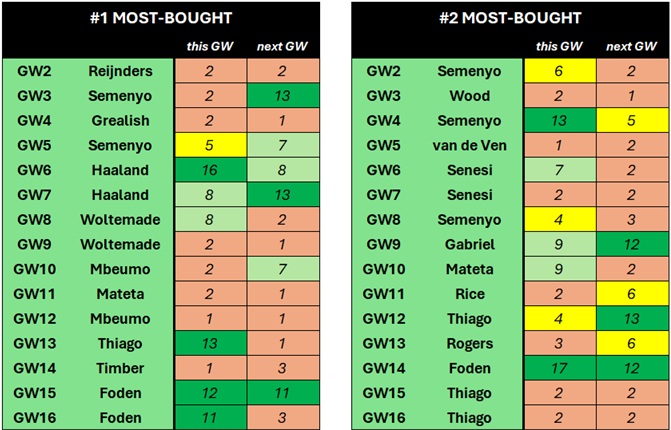
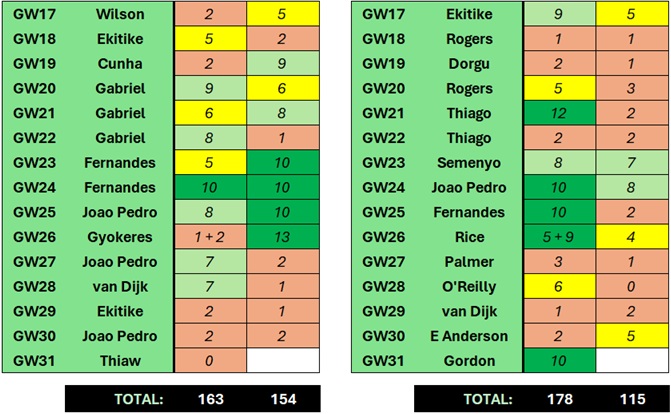
Of the 30 most-bought, just under half of them (14) blanked straight away, including Viktor Gyokeres (£8.8m) in both his Double Gameweek 26 outings.
Eight of these also did nothing in the following round, such as the recent Hugo Ekitike (£9.3m) and Joao Pedro (£7.8m) crazes. Let’s see if Malick Thiaw (£5.1m) can make it three flops in a row when Newcastle United visit Crystal Palace.
However, seven fads brought in a respectable seven to nine points, while five quickly went big. Added together, the best two-Gameweek tallies above came from Erling Haaland (£14.4m, Gameweek 6), Phil Foden (£8.0m, Gameweek 15), Haaland again (Gameweek 7) and Bruno Fernandes (£10.3m, Gameweek 24).
ALL THE NUMBER TWOS
Looking over the next-most purchased, 13 blanked and seven recorded double-digit scores, as Foden (Gameweek 14) and Gabriel Magalhaes (£7.2m, Gameweek 9) were particularly great. Yet 10 did nothing on successive occasions.
The second-most-bought players actually did a little better than their superiors, accumulating 178 immediate points versus 163.
In a week-by-week competition, the #1 won 13-12 against #2, with five draws.
THOUGHTS

It’s easy to get swept up in the mania of individuals like Joao Pedro, Ekitike, Fernandes, Morgan Rogers (£7.5m) and Igor Thiago (£7.3m).
Sometimes it works, as mass investment before Burnley turned out well on all three occasions. But buying in bulk pre-Wolverhampton Wanderers, which has happened five times, went badly for Matheus Cunha (£8.0m) and Ekitike (twice).
On average, the most-purchased player instantaneously brings in 5.43 points and 10.57 over two Gameweeks. Decent enough figures, but not earth-shattering.
Obviously, the success of an individual transfer is not just contingent on stand-alone two-Gameweek scores. There’s the status of the exiting player (Did he need to be sold? Was he injured?), the merits of an alternative transfer target (Is another player a better long-term target, even though their imminent fixture is not as attractive?), team value, chip strategy, etc. The list goes on.
But the above figures are a reminder that sometimes it’s good to step back, avoid all noise and stick to a plan, regardless of fixture. That’s especially advisable early in the season, when unproven, shiny new toys like Tijjani Reijnders (£5.0m) and Nick Woltemade (£6.7m) might seem ‘essential’ – but cooler heads would preach caution.


