


Having only scored two league goals prior to this season, Alex Song was virtually the last player in the Arsenal team expected to find the net with anything approaching regularity this time round. However, the Gunners man has surpassed all expectations with three goals in the nine games he’s played in already, which is, somewhat bizarrely, the same amount as Arsenal’s current main centre forward, Marouanne Chamakh.
After grabbing the 88th minute winner against a resilient West Ham side buoyed by the performance of Rob Green, Song found himself the subject of much praise by Arsene Wenger, who went on to say:
“He is amazing because he came as a centre-back, becomes a defensive midfielder and now he plays like a striker….He has added something to his game. When you sum up his game today he had three good chances: the goal he scored, the one on his right boot and the header in the first half that touched the bar. When you get two or three chances in the game as a defensive midfielder that means you have good timing. He has got the taste to go forward, even if I think a little too much sometimes for a holding midfielder! But that is part of our game as well.”
These passing chalkboards, comparing Saturday’s game with last season’s home match with West Ham, show an attacking side to Song’s game that he has previously failed to utilise.
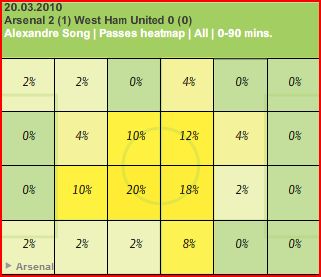
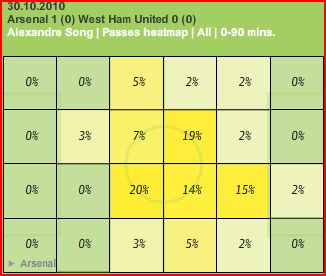
Defensively, in last season’s match (left), 54% of all Song’s passes were made in his own half, whereas just 38% were made in his own half last weekend (right). Going forward, Song made only 6% of his passes in the Hammer’s final third last term, but made a fantastic 23% this time round.
Wenger went on to claim Song’s application in training has played a major part in the turnaround, saying:
He is now a good trainer but this was not always the case. Song has improved his engine and his mobility. He doesn’t need a breather now when he goes and comes back. That has added something to his quality. Now, since he has more stamina capacity, when we win the ball, he is on the move straight away and, when his timing is good, he arrives at the right moment in the box.
These heatmap comparisons from the same two games, showing the ground Song covered last season (left) and this season (right) illustrates his manager’s point perfectly. Last season the vast majority of areas he covered were in his own half, whereas this term, it’s exactly the opposite.
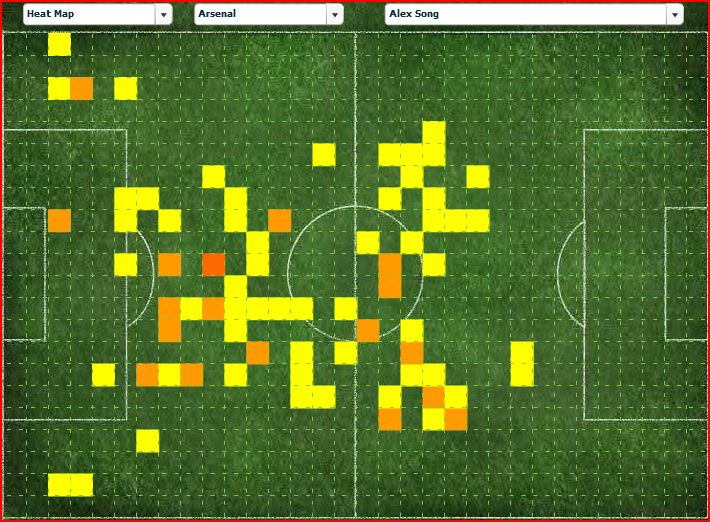
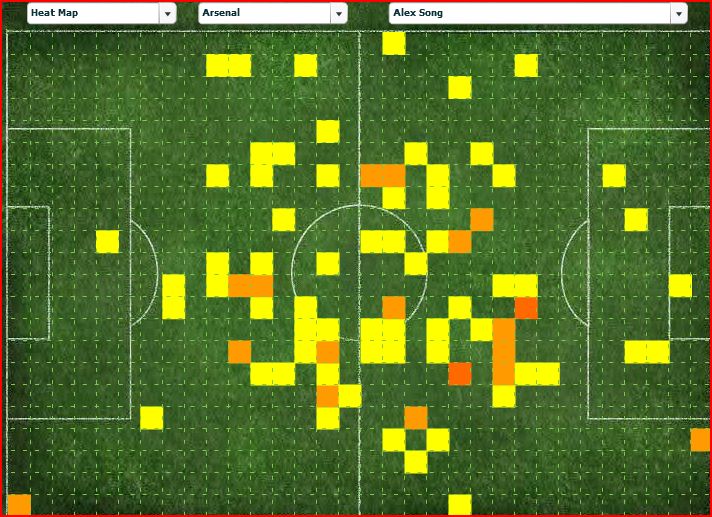
Another example of Song’s increased attacking role is the number of goal attempts he’s had. Through the entirety of last season, Song managed just 10 shots at goal but already he’s had 9 shots at goal with the campaign only just over a quarter done.
In terms of Fantasy Premier League (FPL), Song’s classification as a defender last season saw him a worthwhile proposition, but with him coming in as a midfielder this time round, most people have been clearly deterred. However, with this more attack-minded role, Song’s performances are definitely food for thought. Added to the goals is the fact that he’s still racking up the Bonus Points -he has seven so far already, only three less than Nani- and at just £5.5m and owned by just 2.8% of managers, Song is showing a consistency that suggests this more attacking approach could be a fruitful one.


