


It is widely considered that a defender turned manager has the tactical know-how to build the foundations of a defence capable of returning many a clean sheet. This article examines whether some notable defenders turned managers have lived up to this ideal over the past five seasons and whether Fantasy managers ought to be considering their backlines. This is especially important in preparing for the 2015/16 Fantasy season as it is worth noting that Watford’s manager Quique Flores, Bournemouth’s manager Eddie Howe and West Ham’s new boss Slaven Bilic are all former defenders.
THE TENTH TEAM
In the table below, I’ve included what I call ‘The Tenth Team’. The Tenth Team’s data consists of teams who finished with the tenth highest number of clean sheets and the tenth lowest number of goals conceded for each of the five seasons. For example, in the 10/11 season Newcastle were the tenth best for keeping clean sheets with 9. Then, in the 11/12 season Fulham were the tenth best for shutting out the opposition with 11 clean sheets. For each season these figures are added up to give us the totals for The Tenth Team in the ‘Clean Sheets’ and ‘Goals Conceded’ columns. The reason for using The Tenth Team, is to see what the average team got in each season and then compare it to the selected managers to see whether their defences were better than the average defence.
Clean Sheets
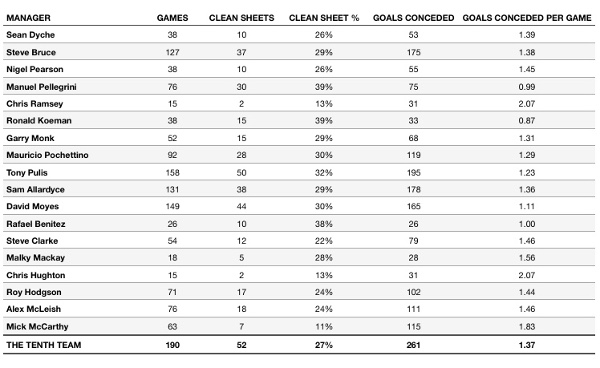
Ten of the 18 managers featured here achieved a greater clean sheet percentage than The Tenth Team’s 27%, with a further four being 1-3% lower.
Manuel Pellegrini, Ronald Koeman and Rafael Benitez have recorded the highest clean sheet percentage. This is Koeman’s first year in charge of a Premier League team and he has done outstandingly well considering that two of the back four were sold on and a new keeper was brought in. Over the past five seasons, top-four clubs have kept a clean sheet in 39% of their matches, which is in line with Pellegrini and Benitez’s tallies.
Of the four managers who got less than 24% of clean sheets in their matches, three were sacked and three of the teams were ultimately relegated. Chris Ramsey was in charge of QPR for 15 games this season, where he lost the battle for survival and finished bottom. Most will say QPR were doomed before Ramsey took charge, though. In the previous season, Chris Hughton was sacked by Norwich after 15 matches in the Premier League, and his replacement failed in his attempt to avoid relegation. During Mick McCarthy’s penultimate season in charge of Wolves – and Wolves’ penultimate season in the Premier League – they flirted with relegation, narrowly missing out in the 10/11 season. Wolves started off their last season in the Premier League strong and stable, but that wasn’t enough to stop McCarthy being sacked in the February. Steve Clarke’s 12/13 season in charge of West Brom was a very good one. West Brom found themselves in the top five a lot during the first 15 weeks, reaching the heights of third, finally finishing the season eighth. The following season didn’t start quite the same – dipping into the relegation places before climbing up to tenth. West Brom then steadily dropped down to 16th place – which was when Steve Clarke got the sack. In a month or two’s time, West Brom were back into the relegation places, and finished the season 17th, only just staying up.
CONCLUSION
It is clear that, if a manager who has experience playing as a defender is managing a team who has cemented itself in the Premier League, then they should, in most cases, deliver above the average number of clean sheets. If a team looks like they may be relegated, then they may not have the quality in their defence to keep a reasonable number of clean sheets – which is common knowledge regardless of the manager’s past experiences.
Notes: For this analysis, I did not include John Carver, as he was only a temporary coach. Nor did I include Brendan Rodgers who, despite being a defender, was forced to retire at the age of 20 due to a genetic knee condition.


