


As Fantasy Premier League (FPL) becomes more mainstream and the community around it grows larger, managers are becoming focused on overall rank more than ever before. Yet most of us first became serious about playing FPL because we wanted to win our mini-leagues or beat a specific rival. In fact, most of us ‘got good’ by focusing not on effective ownership percentages but by concentrating on the strengths and weaknesses that we could exploit in a handful of our opponents’ squads.
Is there something to be said for this scaled-down, mini-league-oriented approach to the game? Can we get better results by focusing on beating just eight people rather than eight million? That will be the focus of this week’s article.
Ownership

Players ownership is what it sounds like; the number of managers who have a certain player, whereas effective ownership (EO) is the popularity of a player once you have factored in those who have captained or benched them during a Gameweek. Ownership is something you see and hear discussed a lot in FPL circles. The basic principle is that a player with very high ownership or EO won’t do much to help your rank but is very dangerous to go without, while a player with very low EO has the potential to boost your rank enormously but also isn’t somebody you necessarily need to lose sleep over not owning. Then you have the whole range in between. Henceforth, in this article, we’ll refer to both player ownership and EO as just ‘ownership’.
These percentages are a way to break down the data of eight million FPL squads into something more digestible. It allows you to identify threats and opportunities in the overall game in a way that you might do in a mini-league simply by observing the squads of your rivals. In this sense, having an awareness of the ownership of players is strategically valuable, allowing you to manage risk and identify opportunities on a macro level.
But ownership can still be overwhelming or, at the very least, distracting. Sure, going without a player with 180% EO is intimidating, but what about a player with 90%, 70%, 50%, even 20%? Ownership can make every player seem essential and the result is often an overly conservative approach to the game. Our transfers become dictated by the perceived need to cover the biggest threats to our rank and we spend less time thinking about the more progressive opportunities that might be available to us.
I know many people will read that and think “Well, maybe for some people, but that’s not me” and it could indeed be the case that you have a higher risk tolerance than most managers but it is still human nature to prioritise safety first and ownership tends to feed into this instinct. Whether you submit to it or not, as soon as you are aware of ownership, it is already influencing your decision process.
The mini-league alternative

As mentioned, most of us didn’t start our FPL careers aiming to break into the top 10k or win the whole thing, we simply wanted to beat our annoying boss in the work mini-league. Initially, our focus was just on defeating a handful of rivals and this is a resilient dynamic within FPL. Even former overall winners will tell you that many of them didn’t feel like they were playing against millions of people, their ‘mini-league’ became anyone who could realistically win FPL instead of them.
There is a natural tendency to identify particular rivals and compete against them specifically. Indeed, for many years this very site hosted perhaps the most iconic FPL rivalry of them all – Mark versus Granville – which, for a while, was the foundation of the Scoutcast. Rivalries are engaging, whether you’re directly involved or just observing and, over time, they tend to make us better players (or emotionally-broken husks, it’s a fine line really). But the question, however, is whether this more narrow, rival-oriented focus can produce better results in terms of overall rank than a broader ownership-oriented focus.
The key advantage of focusing on beating your mini-league rivals is that you are able to shut out a lot of the ownership noise and focus on a manageable pool of players. It essentially becomes a scaled-down ‘proxy war’ for the overall game. At this stage of the season, especially if your mini-leagues are close, there’s a good chance that your key rivals’ squads are quite similar to your own. None of you will be looking to move out your star performers, so your differentials probably come down to four or five players who can make a difference.
Current team structure might allow you to move on easily to the next big premium midfielder, whereas your key rivals might struggle to do the same, opening up a big opportunity for you. Or their team may soon be ‘dead-ending’, perhaps necessitating them to play their Wildcard, meaning you can hold a key advantage by keeping yours for a better time.
The dynamics and permutations that come into play when you focus on a small number of rivals are practically endless but they also typically point to small changes that will scrape five points off their lead here and there and add up over time. They are not the big, dramatic (often self-defeating) gestures that you could feel the need to make when you are trying to move up 100,000 places in the overall rankings.
Ultimately what this comes down to is the idea that, if you can beat your rivals and win your mini-leagues, your overall rank will take care of itself. Personally, I think there’s a lot to be said for this idea. Many of my best ranks, especially early on, came without me giving two thoughts to overall rank, I simply wanted to win my mini-leagues. This notion does, of course, depend heavily on the standard of your opponents.
Find good mini-leagues
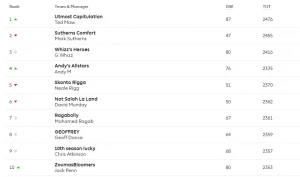
All of us are probably in at least one mini-league that we win regularly without trying much and, equally, we might be in some mini-leagues with hundreds or thousands of competitors. Neither of these is ideal for the purpose at hand. What you ideally want is a league that is small but competitive, filled with people who you know will take the game seriously and give you a run for your money over the whole season.
If you don’t currently have this, look at creating one. Find the ten best players you know and invite them to join. Even if none of you have scored a stellar FPL finish before, the rivalry is likely to improve all of you all as players. Think how Cristiano Ronaldo and Lionel Messi inspired each other to become even greater through their epic rivalry but now it’s you, your brother-in-law and Nathan from the accounting department.
What are the potential downsides? Well, as motivational speaker Jim Rohn once said: “You are the average of the five people you spend the most time with.” While your rivals’ good habits may rub off on you, so might their bad ones too. Just as the hype and bandwagons of FPL Twitter can occasionally steer you wrong, so might those in the microcosm of your mini-leagues. There’s also the danger of becoming too insular and not making moves that might maximise your rank because they’re either irrelevant or too risky within the context of your league. All these need to be taken into consideration but are also mitigatable depending on the quality of your opposition. You can also always invite new people if you think your league has become stale or too much of a bubble.
Conclusion
As the game of FPL gets bigger it becomes less easily manageable, mentally at least. Ownership is one method that can be used to break down player importance into something more digestible but even this can be overwhelming and promotes inertia and conformity more than it does action or independence.
We are never likely to stop chasing those iconic ‘top 10k’ finishes but it could be that a narrower, opponent-focused method might actually be the better way of getting there, given that it allows you to shut out a lot of the noise and focus on exploiting strategic weaknesses in your opponents’ teams which, in all likelihood, will apply on a much wider scale anyway.
Much, however, will depend on who your rivals are. Really competitive mini-leagues have a tendency to forge really good FPL managers, so making sure you’re in one is a good step towards maximising your potential.


