


Fantasy Premier League (FPL) is a pretty mainstream pursuit these days.
Coverage of it is widespread, too. From Sky Sports News and the BBC to national newspapers and ‘celebrity’ players (Neil Robertson, Magnus Carlsen, Stuart Broad… John Ruddy), everyone wants a piece of this burgeoning game.
It wasn’t always the case.
Back in August 2002, FPL as we know it (or something resembling it) launched to little fanfare and modest interest.
Here, we go back in time to the 2002/03 campaign – with the help of the Wayback Machine – to revisit Fantasy Premier League’s humble beginnings and inaugural season.
There is, of course, a story behind the story when it comes to FPL. From ‘play by mail’ to early online UEFA efforts, Fantasy Football was around long before ISM and the Premier League joined forces.
That’s an article for another day, however, as we focus exclusively on a season of now-defunct formations, £3.0m players, an all-or-nothing Bonus Points System, Geremi‘s Dream Team appearance and James Beattie‘s 23-goal heroics.
A FAMILIAR SCORING SYSTEM… BUT WITH A FEW DIFFERENCES

FPL’s scoring system has pretty much remained consistent from the outset. From goals scored and assists to clean sheet and save points, not a great deal has changed in 23 years.
You’ll notice a couple of differences above, however.
Back in the day, midfielders got two points for keeping a clean sheet, not one.
And while there were still bonus points on offer, there was no sliding scale (ie three, two, one). Instead, three bonus points were awarded “for being judged to have made an excellent performance”.
Brilliantly, there was seemingly a) no maximum cap on players receiving bonus or b) an obligation to give any out.
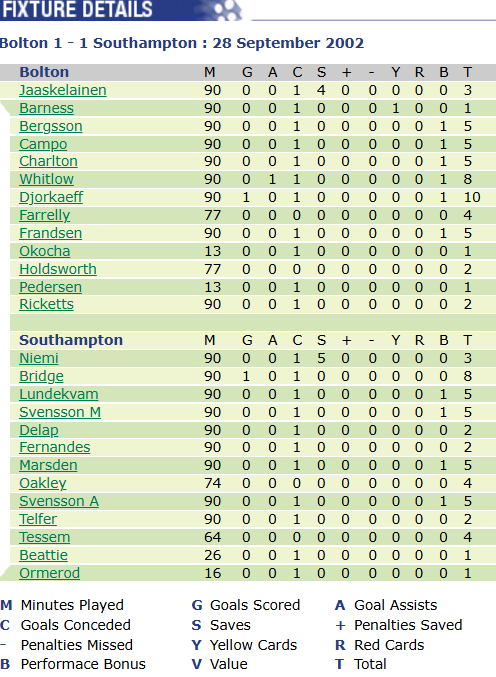
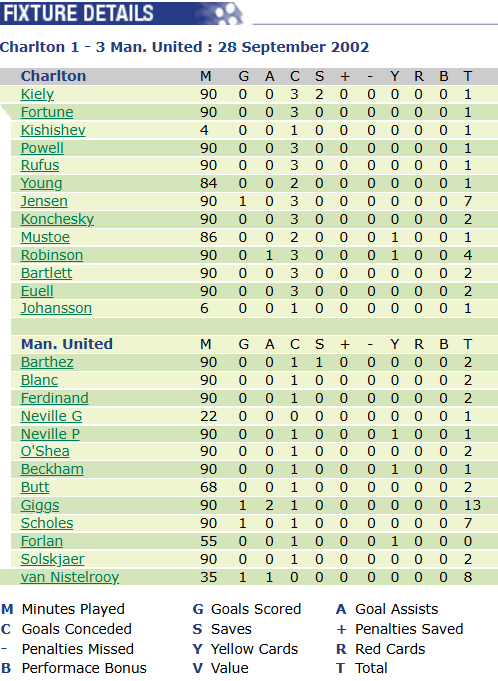
As you’ll see below (click to expand), 10 of the 20 starting outfielders in the Bolton Wanderers v Southampton game in Gameweek 2 were deemed worthy of extra reward. On the same weekend, nobody involved in Manchester United’s win over Charlton Athletic was adjudged to be as deserving. Not even Ryan Giggs, who played a part in all three goals. Imagine the stink if such a system were in operation today…
NO CHIPS, NO CARRIED-OVER TRANSFERS

While the shark was jumped this season with the Mystery Chip, there was a time when there weren’t any chips in FPL at all.
Fantasy managers didn’t even have a Wildcard back in 2002/03. It wasn’t until much later in the decade, in fact, that this particular chip was introduced.
And while we’re all enjoying the ability to roll up to five free transfers in 2024/25, back in the inaugural campaign (and for many years to come), you couldn’t even carry over one. If you didn’t use it, you lost it.
2-5-3 AND 5-5-0 FORMATIONS

The now-discarded ‘All Out Attack’ chip, introduced in 2015/16, allowed FPL managers the chance to start just two defenders and field all front eight players.
There was a time, however, when FPL permitted you to adopt that offensive approach every week.
Back in 2002/03, the ‘2-5-3’ was one of 10 selectable formations that FPL managers could use. Eight of those survive to this day.
The other long-forgotten option was the slightly bonkers 5-5-0 set-up, where you could park all three forwards on the bench.
£3.0m GOALKEEPERS AND DEFENDERS!

While the complete price list from 2002/03 is sadly lost in time (defenders, midfielders and forwards can be found from 2003/04 onwards), the Wayback Machine has preserved the goalkeeper list. The above image dates from November 2002, after some price changes had occurred.
What’s noticeable is that almost half the goalkeepers in the game are under £4.0m. While a lot of these £3.0m/£3.5m options were understudies, you did have the odd starting custodian like Sunderland’s Jurgen Macho.
There were defenders, too, available in the sub-£4.0m bracket. While a comprehensive list isn’t there, we have found some examples: the goal-shy legend that is Tony Hibbert was an early Fantasy cult hero, starting the season at £3.0m.

Sun Jihai, at £3.5m, was another widely owned budget gem.
The existence of dirt-cheap options was offset by more premiums elsewhere. These were the days of £7.0m goalkeepers (Jerzy Dudek, Carlo Cudicini, David Seaman) and £7.0m+ defenders (Sami Hyypia, Rio Ferdinand, Gary Neville, Lauren and an £8.0m Ashley Cole, to name a few).
Coveted midfielders like Harry Kewell, Paul Scholes, Robert Pires, Giggs and David Beckham were all £9.0m+. Even B-listers like Lee Bowyer and Nolberto Solano started out at £8.5m.
Many forwards cost big bucks, too. Thierry Henry and Ruud van Nistelrooy were £11.5m, Jimmy-Floyd Hasselbaink was £11.0m and Alan Shearer started at £10.5m. Eidur Gudjohnsen and Mark Viduka set you back £10.0m apiece.
PRE-SEASON WITHIN A SEASON

While it’s a slick, well-oiled machine these days, FPL was endearingly shambolic some 23 years ago.
The first six Gameweeks (the initial plan was four Gameweeks but there were evidently teething problems) didn’t even count towards your overall score. Instead, the opening half-dozen rounds were classed as ‘pre-season’, as Fantasy managers dipped their toes into the water to get accustomed to the game.
‘The Pundit’ – as the ‘The Scout’ was known in those days – was the only Gameweek 1 entrant, indeed.

THE BIG KICK-OFF

Gameweek 1 (or Gameweek 7 as it should have been) saw the season commence in earnest.
The Tyne-Wear derby got things underway in the lunchtime kick-off on Saturday 21 September, 2002.
Craig Bellamy and Kieron Dyer have claims to fame as the first players to register a goal and an assist, respectively, in FPL proper.
There were a whopping 11 clean sheets across the weekend. Among those emerging with double-digit hauls were Barclaysmen Franck Queudrue, Brad Friedel, Lee Hendrie and Antti Niemi (still far from finished at the age of 30), as well as eventual season top points-scorer Henry.
AN EARLY DOUBLE GAMEWEEK

For as long as there has been FPL, there have been Double Gameweeks.
And the first Double Gameweek proper we had was in Gameweek 4 of 2002/03 (Gameweek 10 as it should have been).
Fulham and West Ham United were the two teams playing twice in that round of fixtures, with successive 1-0 wins for the Hammers seeing such luminaries as Scott Minto and Ian Pearce make that week’s Dream Team.

There was actually an earlier, unofficial Double Gameweek as part of the six-week trial period, with Manchester United and Middlesbrough playing twice. A Ryan Giggs goal and a ‘Boro clean sheet helped two future national-team coaches to double-digit hauls.

More Double Gameweeks – and some big hauls – were to follow in the New Year.
BIGGEST HAULS

Two of the biggest hauls of the campaign came in Double Gameweek 27 (aka Gameweek 33), when Manchester United followed up a remarkable 6-2 win at St James’ Park with a 2-2 draw at Arsenal. Giggs and Scholes both emerged with 22-point returns in that Gameweek.
It’s a figure that Steed Malbranque had matched in Double Gameweek 21 (Gameweek 27) when Fulham played twice.
Scott Parker had become the first player to hit 20 points in a Gameweek, doing so in Charlton Athletic’s double in Gameweek 18 (aka 24).
But all of them were trumped by Pires.
In Arsenal’s Double Gameweek 31 (Gameweek 37), the French winger played twice, scored a hat-trick, assisted another goal and claimed three bonus points en route to a 25-point haul.
2002/03 DREAM TEAM
The FPL Dream Team for 2002/03 includes the points from the six pre-season rounds.
And here it is, in a then-acceptable 2-5-3 set-up:

One player set a record that still stands today.
Friedel’s total of 187 points hasn’t been beaten by another goalkeeper since, with Emiliano Martinez going the closest (falling short by a point) in 2020/21.
Then at Blackburn Rovers, the USA international kept a league-best 15 clean sheets on the way to his landmark tally. Two penalty saves also helped.
It wasn’t quite the same historic season for defenders, with Sami Hyypia‘s so-so 151 the best of the bunch. Only once has a defender made the Dream Team with fewer than Mikael Silvestre‘s total of 141.
A dearth of clean sheets from the big guns in 2002/03 was partly to blame. Arsenal only just made it to double figures for shut-outs, doing so on the final day. Even champions Man Utd only registered 13, two behind Blackburn.
Kewell and Scholes both hit 14 goals (the joint-best among midfielders) on their way to the end-of-season XI, with Giggs reaching double figures for assists to complement his eight strikes.
Frank Lampard made the first of seven Dream Team appearances, despite only contributing six goals and two assists. The extra points on offer for clean sheets (an additional 13 points) and those subjective “excellent performances” (33 points) helped compensate for that.
Geremi is a surprise name, making the cut despite missing the last five Gameweeks. Seven goals and eight assists were a decent return from the Middlesbrough midfielder, along with those bonus/clean sheet extras.
The Premier League’s top three goalscorers unsurprisingly made up the forward line. Van Nistelrooy, Henry and Beattie notched 25, 24 and 23 goals respectively, with Beattie trailing only Henry for overall points.
The Southampton striker cost just £7.5m at the start of 2002/03, rising to £9.0m by the season’s end. A hat-trick against Fulham in Gameweek 5 (or 11) brought him a 17-point haul, the first of five double-digit returns.
HENRY’S 271 POINTS IN FOCUS

Henry was no mere goalscorer. There were almost as many assists (23) as there were goals (24), with 42 bonus points thrown into the mix.
There were 10 double-digit hauls, with the Arsenal legend saving the best till last: 19 points in Double Gameweek 31/37 before an 18-point return on the final day.
The Frenchman could even afford to get booked eight times and miss a penalty en route to 271 points.
Henry would go on to make the next three Dream Teams. His 2002/03 points tally was also not beaten for another five years (Cristiano Ronaldo‘s 284 in 2007/08).
FPL’S FIRST EVER WINNER

FPL’s first-ever winner was Graeme Haddow, who finished ahead of over 76,000 others. That’s just 0.7% of the total number of teams in FPL this season.
From a Gameweek 1 rank of 3,112, the Newcastle fan rose to the summit for the first time in Gameweek 22/28.
Handing the armband to a hauling Henry on the final day, Haddow ended up six points clear of his nearest rival.
That closest challenger was Emile Heskey (that one?), who really ought to have had his own name on the virtual trophy.
The eventual runner-up ended with autosub David Sommeil – who delivered two points – as captain in the final Gameweek after a no-show from Harry Kewell. No nominated vice-captains in those days…
A FAMILIAR NAME

Finally, a word on the one surviving player from 2002/03 who is still in FPL today.
A 16-year-old James Milner entered the game midway through the season as a £4.0m midfielder (the lowest starting price for a midfielder back then), going on to make one start and 17 substitute appearances for Leeds United.
He’s appeared in all of the subsequent 22 FPL seasons since.
Let us know how much – if anything – you remember of FPL 2002/03 below.


